

The Problem with Most Problems
Most problems make you a commodity. The right one makes you a monopoly.

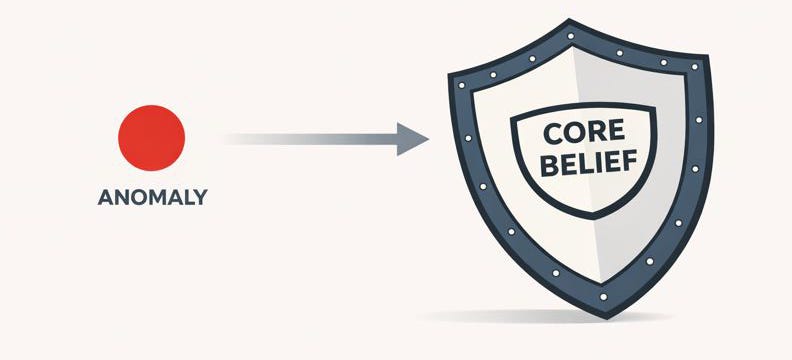
Founders are often advised to sell painkillers, not vitamins. But even when people think of painful problems to solve, they look in conventional ways for things people dislike or things people wish they had. These are conventional problems. They assume solutions can be found within the rules of today’s reality.
Ask someone in 2007 what frustrated them about travel. They’d say hotels were too expensive or too far away. Nobody said, “I wish I could stay in a stranger’s apartment.”

An explanatory problem is different. It arises when reality doesn’t behave the way the prevailing explanation says it should. Something is happening that shouldn’t be, or something isn’t happening that should be. The problem isn’t that customers are frustrated. The problem is that everyone’s understanding of reality is incomplete.
That difference is everything. Conventional pain points you toward what customers want improved in the current frame. Contradictions point you toward what’s wrong with the consensus view of the frame entirely. Starting with pain invites you to improve the current game. Starting with a contradiction invites you to reframe which game gets played.
When you find a contradiction, you’ve found a crack in the rules themselves.
Stumbling Into Cracks
Founders encounter contradictions in different ways.
Some stumble into them.
The Airbnb founders threw up a WordPress site offering air mattresses during a design conference. It wasn’t intended to be the startup idea they planned to work on. It was created out of desperation, because they couldn’t make rent. The response to their makeshift site surprised them. The standard theory was that strangers won’t trust each other with accommodations. But if that was right, very few people should have wanted something like this, and yet they did. Brian Chesky, Nate Blecharczyk, and Joe Gebbia weren’t looking for a contradiction. They tripped over one.
Others find them by living in the future.
When Palmer Luckey duct-taped smartphone screens to ski goggles in his parents’ garage, he wasn’t solving anyone’s pain point. He was discovering something the VR industry had missed: smartphone components had gotten cheap enough and good enough that consumer VR was now possible without the $10,000 headsets everyone assumed were required. He posted his prototype on hobbyist forums. The response was overwhelming, from people who shouldn’t have even existed. Even though the VR market had been declared dead, these customers didn’t “know” that.
Either way, what they find isn’t a painful problem to be solved within the current frame. It’s a sign that the frame itself is incomplete. Reality and belief had diverged, and in both cases they noticed.
The Creative Leap
I used to think insights were things you found. You scan the landscape, spot the market need, connect the dots.
But that’s backwards.
Insights aren’t found. They’re imagined. A thousand people can see the same strange data. Most see noise, or an exception that seems OK to ignore. But one person sees a crack in the foundation of how everyone thinks. The difference isn’t better eyesight. It’s a different way of seeing.
The observation without the explanation is trivia. The explanation without the observation is speculation. Together, they form an insight that can change the future.
How Contradictions Stay Hidden
Broken explanations don’t collapse on their own. They defend themselves through what philosopher and physicist David Deutsch calls “patches,” which are reasons people come up with to convince themselves why the anomaly doesn’t count.
“Those early customers are a tiny market.”
“That only works in San Francisco.”
“Smart people have tried this and failed.”
Each patch lets the old explanation survive another day. From inside the frame, the anomaly looks like noise that can be explained away. From outside, it becomes obviously significant. Patches don’t just defend bad explanations. They also hide contradictions from people inside the explanation.
When Chesky and Gebbia pitched the air mattress idea, the patches came fast. “Normal travelers would never do this.” I know, because I made the mistake myself. In my pass note to Brian Chesky, I said I had concerns about travel-oriented startups. A masterpiece of missing the point.
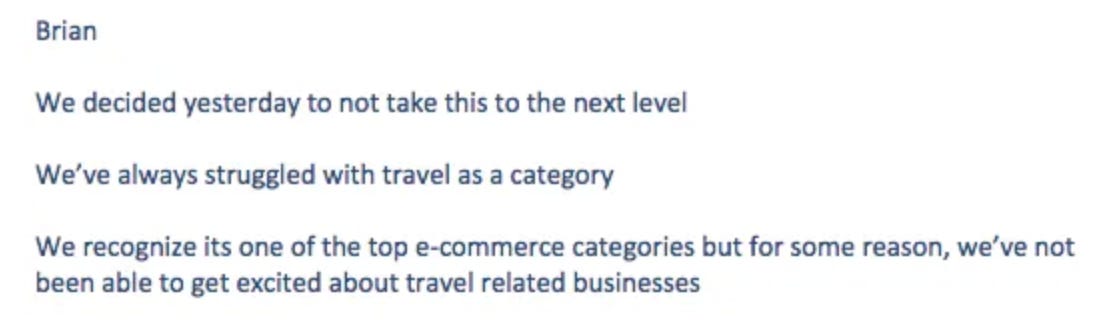
Every patch was a way of saying, “The old explanation is fine, and the new anomaly isn’t important.” Or “The new anomaly makes my head hurt and belongs in the too-hard bucket.”
But the anomaly was real. And the patches were clues about how much more valuable it would be to get to the new explanation.
The Identity Trap
If hunting for contradictions is so powerful, why don’t more people do it?
Because most people’s identities are entangled with prevailing explanations. The investor who built a career on the thesis that “marketplaces require managed supply” won’t easily see the potential of Airbnb. The pharma executive who rose through a system built on blockbuster drugs and ten-year trials can’t easily see that the explanation for how cures are invented might be broken. The designer who mastered Photoshop has status wrapped up in that mastery and might not be awake to the possibility of Figma’s multiplayer design.
Seeing contradictions requires psychological distance from those types of things and the willingness to hold your own expertise lightly. You need to treat your hard-won mental models as provisional, and most people just can’t do this. Not because they’re stupid, but because their sense of self depends on the current explanation being right.
This is another reason that breakthrough founders are often outsiders, immigrants, or people early in their careers. They haven’t yet accumulated the identity attachments that make contradictions invisible and current beliefs of the current frame hard to let go of.
The Monopoly Window
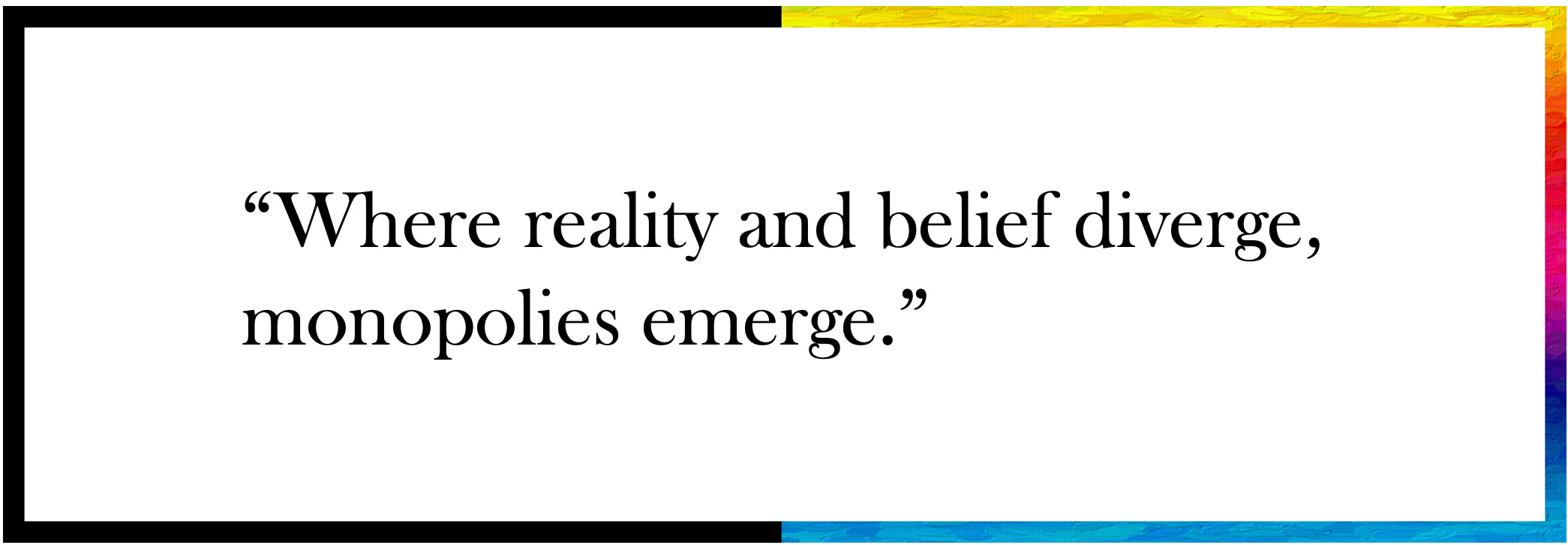
A contradiction means a new reality and conventional belief have diverged. Most investors, competitors, and potential hires can’t see the opportunity because their legacy explanation actively hides it from them.
This makes convincing others harder. But it also creates time.
While everyone else fights over incremental improvements to painful problems inside the accepted frame, you’re building alone in territory they’ve defined as empty or impossible. You have some time where you are in your own sandbox and get to define it. By the time the contradiction becomes better understood and people start taking the new frame seriously, you’ve hopefully been compounding for years.
Hold the Anomaly Tight; Hold Your Explanations Loose
Even if you are right about the contradiction you’ve found, your initial theory about what the anomaly means is probably wrong. It might be less wrong than the prevailing view, but it will still be wrong in its own ways.
Lots of founders defend their position once they’ve staked it. They add patches of their own when reality pushes back. They blame execution or the fact that others don’t get it when the patches fail.
The Airbnb founders did the opposite. When bookings stalled, they didn’t protect their theory. They interrogated it. Paul Graham suggested they visit their most engaged hosts in New York. One host pulled out a notebook filled with suggestions. Later, they added professional photography to enhance trust. They incorporated Facebook Connect to reduce stranger-danger.
Each move was a correction. They kept interrogating where their own beliefs diverged from what was actually happening. They were stubborn about the anomaly that people will stay with strangers. But they held the exact implementation details of how best to deliver an experience loosely.
Competitors can copy features or strategy. They can’t copy a history of disciplined error correction. That history is your moat.
Stress Testing
If you think you’ve found a contradiction, it’s good to stress test it with a few questions:
What does everyone believe?
What would we expect if that belief were true?
What are we actually observing?
Why can’t the prevalent belief account for it?
Slack: Everyone believed workplace communication was solved—email handles async, and enterprise chat had been tried without gaining traction. If true, teams would ignore yet another chat tool. Instead, when Butterfield’s game team built an internal chat tool, people started leaving it open all day. They got anxious when they couldn’t check it. Engineers started @mentioning each other instead of walking ten feet. The tool was supposed to be a side project. It became the company. The behavior didn’t match the theory.
Figma: Everyone believed design is a solo activity requiring native desktop applications. If true, handoffs would be a minor nuisance—you just send the file. Instead, designers spent hours each week hunting for “final_v3_REAL_final.psd.” Engineers built from outdated specs. The coordination overhead was enormous for something supposedly done alone. Design wasn’t solo work pretending to be collaborative. It was collaborative work trapped in solo tools.
In each case, reality and belief had diverged. And someone was awake enough to notice.
The Choice
At the foundation of almost every breakthrough company is the same fact:
Reality was being mis-explained.
And one startup team guessed at a theory that made the anomaly meaningful. Then they took the time and space to build something remarkable and unique while others fought over painful problems inside existing frames.
Most founders scan the landscape looking for pain and often find something compelling. But so do a lot of other people. They end up entering crowded races where the prize is incremental improvement and the competition is brutal.
A few founders do something different. They find the anomaly that is real but invisible to people inside the old frame.
They build alone, at first.
And by the time the world catches up, they’ve already won.
The classic VC line “ideas are a dime a dozen” was true in a world where execution was scarce, slow, and expensive. In that regime, the idea itself mattered less than the team’s ability to grind through years of uncertainty and operational friction.
AI changes that regime.
We are approaching an inflection point where execution is increasingly cheap, fast, and commoditized. Code, design, copy, analysis, even early go-to-market are no longer the bottleneck they once were. If execution is no longer scarce, then the old wisdom collapses — and with it the framing of what actually creates value in a startup.
This connects directly to the article’s distinction between “painful problems” and contradictions. Painful problems live inside the existing frame. They assume the world is correctly explained and ask how to optimize within it. In an AI world, those problems will be attacked by thousands of teams simultaneously, because cheap execution makes incremental improvement easy and crowded.
Breakthroughs, by contrast, come from identifying where reality and conventional thinking have diverged — where something works (or fails) that should not, according to the dominant explanation. That is not an execution problem. It is a perception problem.
What becomes valuable, then, is not “the idea” in isolation, and not execution in the classical sense, but the ability to:
• identify a real inflection in the world,
• notice the contradiction it creates with prevailing beliefs,
• form a new explanatory model that makes the anomaly make sense,
• and articulate it as a coherent narrative or movement that others can align around.
AI doesn’t eliminate the value of ideas; it shifts the value toward a very specific kind of idea: one that re-frames reality rather than optimizes within it.
If both ideas-as-features and execution-as-labor are commoditized, what remains scarce is agency grounded in insight — the willingness and ability to act on a non-consensus explanation of the world before it is socially validated. That is exactly what the article describes as the monopoly window.
@Mike Maples, Jr you nailed it! "Most see noise, or an exception that seems OK to ignore. But one person sees a crack in the foundation of how everyone thinks. The difference isn’t better eyesight. It’s a different way of seeing.
“Notice what other people don’t see.” - Rick Rubin