

Why I'm Supporting the Conjecture Institute
Breakthroughs Begin with Better Explanations

The Eureka Myth
When it comes to breakthroughs, people love to romanticize the moment of conception. We like to imagine Newton under the apple tree, or Einstein having the “happy thought” that led to his theory of relativity. Or, in my world, the founder sketching a Thunderlizard startup idea on a napkin at 2 a.m.
But the truth is that breakthroughs happen differently. They start with anomalies. Something feels off. The tidy story everyone repeats about how things work suddenly has a crack in it. Most people shrug and keep moving. But a few pause, and ask, “Wait… what’s going on here?” And then they keep asking.
The founders of Lyft took the time to question what others had taken for granted: taxis were scarce because cities limited supply with regulations, medallions, and all sorts of bureaucratic fences. But Logan Green and John Zimmer noticed something that didn’t match the script. Cities weren’t short on cars at all. They were overflowing with them. Cars parked along curbs, they were stuck in traffic, and they were often driven by people who could use some extra cash. The supposed “scarcity” wasn’t a real shortage. It was an anomaly of a wrong explanation. So they started saying something that sounded almost too simple at first: the problem in cities wasn’t a lack of cars to give rides, it was a matching problem. If you could link riders with all the underused drivers already on the road, the constraint pretty much disappeared. Lyft wasn’t just another app on a phone. It installed a new and better theory of how cities move.
Here’s the mechanism I keep noticing: Every genuinely transformative company I’ve come across starts with someone spotting a crack between the story everyone believes and what’s actually happening on the ground. Instead of brushing it off as random noise, they treat it like a clue. Then they build a completely new explanation. Sometimes it’s rough at first and needs to be further refined, but it ends up reshaping how people see reality.
What David Deutsch Gave Me
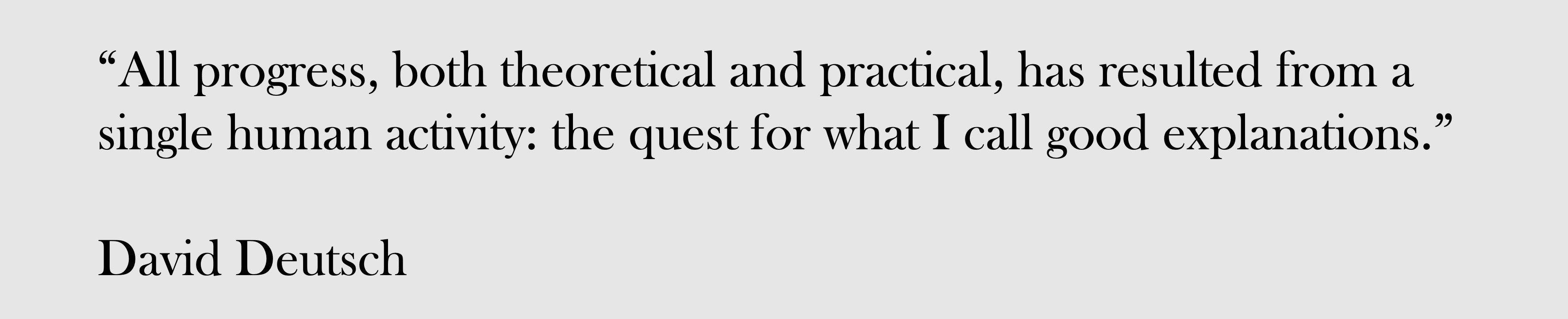
Physicist and philosopher David Deutsch gave me a language that helped me clarify my understanding. In The Beginning of Infinity, he argues that progress consists of the quest for good explanations. And he offers a test: Can you change its parts without changing its predictions and ability to explain what it is supposed to explain? Does it survive all the ways you can think of criticizing it?

Criticism is the Mechanism
The last point is the one that matters most. Criticism isn’t an obstacle to overcome. It’s the mechanism that helps you distill better explanations. The insights that hold up under real pressure become the foundation you can actually build on. The ones that collapse were never real explanations to begin with; they were just stories dressed up as insight.
Most startup frameworks miss this. Pattern matching, execution playbooks, and growth hacks are all useful once you actually know what game you’re in. But early on, you don’t have enough signal for patterns to tell you anything reliable. You’re not judging metrics; you’re judging the cause and effect explanation for how they make sense of a new reality. The quality of that model ends up driving everything that follows.
Figma leaned into the belief that design was inherently collaborative, not solitary. Stripe bet that developers—not banks—would become the real distribution engine for global payments. These weren’t just product choices. They were explanatory bets. And when a new explanation turns out to be right, the world suddenly expands. Constraints that felt permanent become solvable problems. Entire categories shift. Second- and third-order openings appear that were invisible before.
This is why I’m supporting the Conjecture Institute.
The Conjecture Institute - Infrastructure for Human Progress
If progress comes from finding better explanations, then an institution dedicated to cultivating them isn’t academic. It’s infrastructure for human progress itself. Conjecture surfaces boundary problems that founders overlook. It helps generate candidate explanations with genuine reach into surprising areas of the world. It creates environments where weak explanations break early—before anyone builds a company on them. It helps people see that a contradiction isn’t a failure. It’s a clue that helps you figure out what to do next.
Conjecture Institute was founded less than a year ago, and their model is already paying off. They’ve published two books, one of which, The Sovereign Child, has sold over 20,000 copies. They’ve given support to thirteen Fellows: an AGI researcher, three physicists, a mathematician, a podcaster, a video animator, an epistemology educator, a science educator, a philosopher, a defender of the Enlightenment, a designer, and a generalist. They’ve also enlisted a Senior Scientist, Oxford’s Chiara Marletto, to their roster. Many of their Fellows have published original research in physics and other deep fields that have solved fundamental problems—check out their website for details. They’ve also hosted an in-person event attended by over 75 people from across the world.
Among so many other things, Conjecture Institute is offering an effective alternative to the academic system that is slowing down progress in science and elsewhere.
Amazingly, Conjecture Institute’s internal team consists of only three people—its cofounders. To say that they have a low overhead would be an understatement.
This is one of the highest-leverage bets I can make. It improves the source code of innovation itself: how people reason about the world.
Deutsch didn’t change how I think about founders, but he definitely sharpened it. The people who end up driving the biggest shifts usually share three habits. They notice when the accepted explanation has gotten out of sync with what’s actually happening. They build a stronger one that has real range, and is not just a clever tweak. And they treat early criticism as a tool for improving their model, not a threat to whatever story they want to tell.
Explanatory Investing
Execution, capital, market pull, and timing clearly matter. But the explanation a founder is working from sets the slope of the hill they’re climbing.
When I meet a founder now, I’m asking one question beneath all the others: Is this person operating from a better explanation, or just following a pattern that worked before?
Here is the loop that captures it:
Find the contradiction by noticing where reality refuses to match the accepted story. Create a candidate explanation and make it hard to vary (no part of it should be arbitrary). Look for ways that it reaches beyond the problem it was proposed to solve and solves other problems that had seemed distant. Then expose it to criticism by letting smart people try to break it. Build on what survives. And when new contradictions appear, don’t flinch. Treat them as the next problem worth solving—ideally, with an even better explanation.
This is how breakthroughs originate. Not from flashes of genius, but from the patient, unglamorous work of noticing what doesn’t fit—and refusing to look away.
Supporting the Conjecture Institute
Supporting Conjecture Institute is one of my bets on that process. I highly encourage you to check them out and do the same.
Or, get in touch with their President, Logan Chipkin, at logan@conjectureinstitute.org. He’d be happy to tell you more about the details.
Thank you for supporting Conjecture Institute, Mike!